These days, it’s hard to imagine Paris without the Eiffel Tower. And yet, it came very close to disappearing from the city a hundred years ago. According to reports, in 1925 Henry Ford tried to buy the Eiffel Tower and have it shipped to Detroit. André Citroën managed to prevent that.
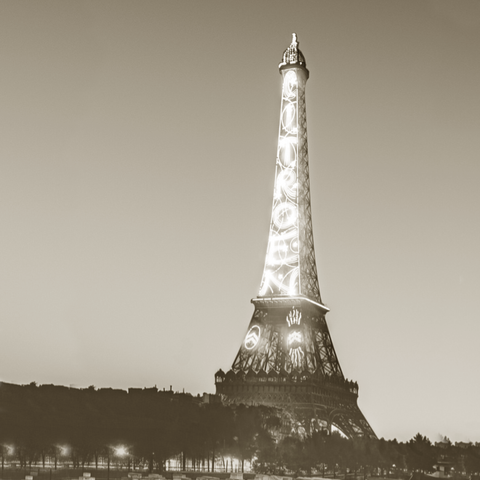
It is 1925, and preparations for the Exposition Internationale des Arts Décoratifs et Industriels Modernes in Paris are in full swing. The Eiffel Tower’s management also wants to take part in the exhibition and approaches artist Fernand Jacopozzi, asking him to design a light show for the tower. Various plans were drawn up, but it soon became clear that the project would cost so much that a sponsor was essential. Jacopozzi took his plans to André Citroën, who immediately saw an opportunity: the Eiffel Tower as a gigantic illuminated billboard. However, he hesitated because of the project’s high cost.
The story goes that the Eiffel Tower’s management was approached at that point by an employee of Henry Ford from America, who claimed he wanted to buy the tower on his boss’s behalf. André Citroën got wind of Ford’s plans and realized that he shouldn’t let his competitor have this opportunity: before Ford could seal the deal, Citroën leased the Eiffel Tower and agreed to Jacopozzi’s plans.
Some later claimed that the story about Ford was made up to persuade Citroën, but whatever the case, the fact is that the tower remained in Paris, and work then began in earnest to realize Jacopozzi’s design. Philips supplied 200,000 light bulbs, which acrobats and marines installed on the outside of the tower. The installation was wired with 33 kilometers of thin cable and 56 kilometers of thick cable.

On July 3, 1925, at 10 p.m., André Citroën took his wife and children to the Esplanade du Trocadéro, which overlooks the Eiffel Tower. That evening, the first test of the light show designed by Jacopozzi was to take place. A magical moment. The following day, the show officially premiered. A spectacular and unprecedented publicity stunt by Citroën. It was the biggest advertisement in the world, visible from 40 kilometers away in clear weather. In 1927, Charles Lindbergh, who was the first to fly nonstop across the Atlantic Ocean, even claimed that he had used the name Citroën on the tower as a landmark when he was over France.
Citroën had got a taste for success and had the light show renewed fairly regularly in the following years. Only at the end of 1936 did the lights go out for good. Although… mark April 28 this year on your calendar and keep an eye on Citrovisie’s Facebook page…