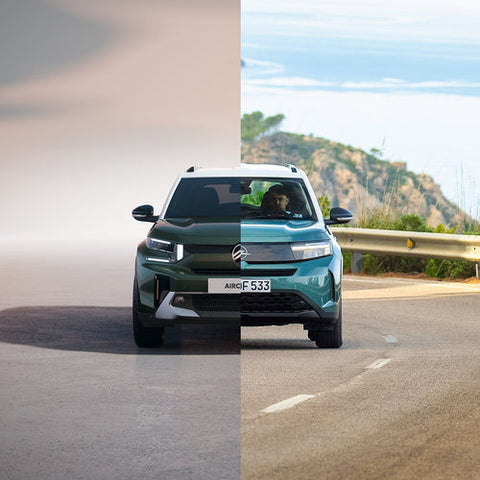
Now that Opel and Citroën both belong to the Stellantis Group, it’s no surprise that they share technologies, platforms, and even models. For example, the Opel Rocks is actually a Citroën Ami, and the new Frontera also shares its DNA with Citroën’s C3 Aircross. But did you know that a hundred years ago, there was already an Opel inspired by a Citroën?
After André Citroën replaced the Type A with the B2 in the spring of 1921, he added a second model to the lineup a year later: the compact 5HP. The model was a success, not only because of its low price, but also thanks to André Citroën’s clever marketing, which specifically targeted female buyers. The 5HP soon earned the nickname P’tit Citron (little lemon) because many examples were delivered in yellow.
Opel expected that such a model might also be a success in Germany, and launched the 4 PS in 1924. Because of its green bodywork, the model was nicknamed Laubfrosch, meaning tree frog. The 4 PS was the first German car built on an assembly line - a principle Opel had borrowed from Citroën. And there were more similarities. Not only did its bodywork look very much like that of the Citroën 5HP, but its engineering also seemed to have been copied from its French rival. The wheelbase was exactly the same, and under the Opel’s hood was a small, four-cylinder, water-cooled, side-valve engine, just like in the Citroën. Only the engine displacement differed.
Citroën sued Opel for plagiarism, and the case eventually went to court. Oddly enough, it was Opel, not Citroën, that won! On June 25, 1927, a German court ruled that there were indeed striking similarities between the two models, but that it could not be proven that Opel had copied Citroën’s 5HP, since there were also differences. The shape of the radiator was cited as an example. Opel was therefore allowed to continue producing the Laubfrosch. But in German, “Dasselbe un Grün” (the same, but in green) has since become a well-known expression for saying that something really isn’t different at all.